Saturday, 10 August 2013

Tips and wrinkles.


What is the best bit of advice you've ever been given? Who gave it to you and when? Do you live by it?

Ask a few of your friends and family for the best bit of advice they got and why? Ask who gave it to them?

You'll get some fantastic answers and if you have enough pieces of good advice you could compile one of those little books of helpful ideas.


What's the worst bit of advice you have ever had? Who gave it to you and what happened when you followed it?  There's another little book in the making but more of a dark book or tragic comedy.

What bit of advice do you give. Have you ever taken it yourself?

The best bit of advice I had was written down. It said .....to love life is to love many things....I think that's true. The advice I give people is to accept yourself as you are and forgive your limitations. Good advice or a cop out?..

Thursday, 8 August 2013

Music.

Music is a big part of our lives regardless of who we are and where we are from. As a writing exercise choose two or three pieces of music that are important to you. Play them if you can and then immediately after write notes about the memories they invoke.

Can you make these recollections into a story? This may involve standing back from the memories you have evoked and writing about yourself as a fictional character.

Try writing continually for five minutes about your music and what it makes you think of. Write  stream of consciousness.

Could you write a poem of any style made from your recollections?

If you wrote about all the songs that have formed a soundtrack to your life you might have a novel...


I'm thinking now about Kung fu fighting. It always reminds me of a fantastic holiday I had as a kid.

Sunday, 28 July 2013

Secrets in noisy cupboards


This piece of furniture is French. What makes it French is the long drawer in the middle which has been designed to store baguettes. It's an entirely functional piece of furniture intended to be very useful but the cupboards are stiff and open with difficulty and a loud noise. 

Create a scenario in which a person wants to retrieve an important document from the cupboard but can't because the house is never empty and opening the cupboards alerts everyone's attention. Imagine the document is a birth certificate that contains proof or evidence of great importance to the character.

The person is motivated to recover this document and this motivation drives him or her forward to take risks and think resourcefully. Motivation, risk and resourcefulness are wonderful ingredients for drama. 

This scenario could be very funny or it could be sinister or a combination of the two.

Think about why the document is important.
What will happen when the evidence is found?
Why can't the protagonist just walk up to the cupboard and open it?
Why is the protagonist so powerless?
Who in the household is the protagonist scared of offending or causing trouble with?

There's a film in this... or a novel...if you keep writing.

Is there a place in your home where secrets are kept?
Who keeps them and why?

Wednesday, 24 July 2013

Names and their influence.

The Royal couple have named their baby boy George. I wonder what his name would have been had he been a girl. A friend of mine - very muscled and masculine - told me his mum was going to call him Janet if he had been born a girl. Janet??? I could never look at him without thinking of him with that name.

My parents would have called me Blake if I'd been born a boy. 


What were the names your parents chose for you - the ones they didn't use?
How would your life have been different with another name?
If you are a parent, what names did you write on a list for your expected child? What made you pick the one you chose and reject the others?

Are you named after anyone? 

Write a story beginning with a name you might have had and go on to describe a day in the life of the person you might have been.

Saturday, 20 July 2013

Fulfilling small ambitions.

I made these pottery items. I made lots more but they aren't ready to bring home yet as they need to be fired and glazed. Pottery is something I've always wanted to try but always put off. The six classes I took were very relaxing and I'm now glad I've fulfilled a small ambition.


What hobby or new occupation have you wanted to try?
Why haven't you done it yet?

1) Could you write a story about someone (it could be you) who dreamed of doing something like pottery or asking someone for a date and then did it?

Were their expectations met or exceeded or was the activity a disappointment?
Write a story with a traditional start middle and end structure.

2) What about a story about someone doing something they didn't want to do or dreaded like paint-balling or standing up to a difficult person. You could try a different story structure such as writing your story as a diary for example.


What happens to make a person have to do these things?

Sometimes we can be surprised to find ourselves enjoying something unexpected, or facing up to something difficult with good courage.

The two scenarios will give you very different stories.

Thursday, 18 July 2013

Get it write.


I read a book from a mainstream publisher that had several typos in it. I found this so odd that when I came across them they distracted me from the story as I pondered the reason...staff cuts, someone rushing because of a heavy workload...I once read a self published book that told a good story in such appalling English that it spoiled the book and its chances of a good review or recommendations. The best story in the world won't get past an editor if it contains mistakes that the writer should have spotted.

Spelling and grammar are important elements of the written word. 

Your spell check won't find all the mistakes in your work and the best way to see them yourself is to print work off, rather than editing it from the screen.

Reading work aloud is another way of finding errors as is leaving work for a couple of weeks before re-checking it. Having a break from a piece of work is a good way to see it again as though for the first time. 

Create a list of the mistakes you commonly make. I always struggle to spell rhyme and manoeuvre and have to go carefully when I want to use whose or who's.

Keep the list handy for when you are writing.

Write a short story about someone who can't spell and the effect this has on their life. 

Saturday, 13 July 2013

Edgar Allan Poe


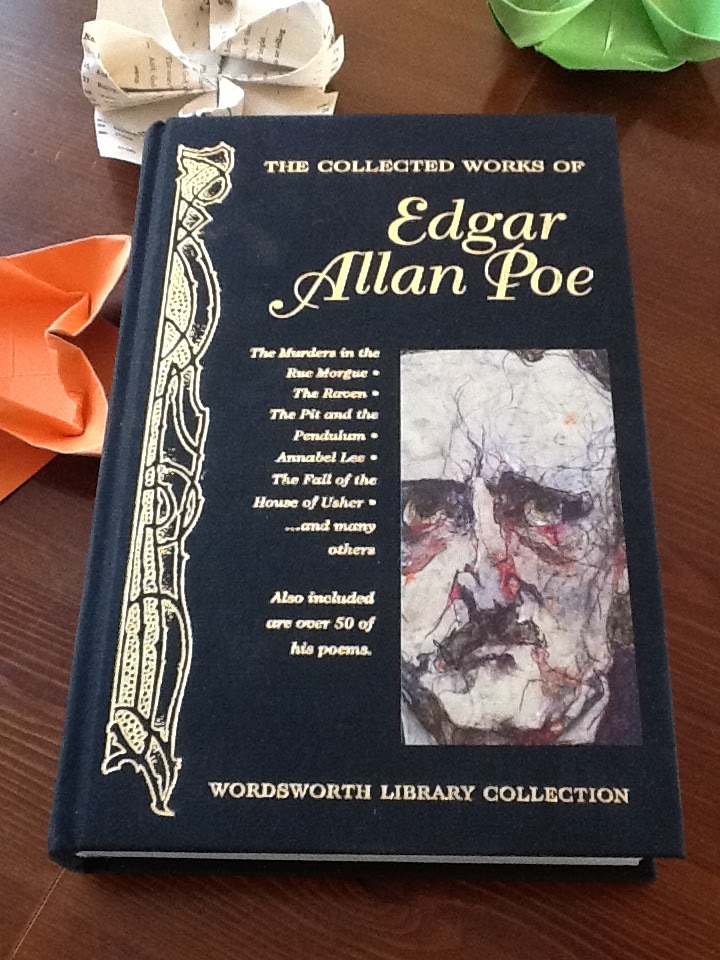
I'm working my way through a number of ghost stories so that when I begin the September term I have a few choice examples to use in my lessons. The pictured book of Edgar Allan Poe's works is full of stories with the most fabulous titles. Von Kempelen and his Discovery, Mesmeric Revelation, The Devil in the Belfry, The Premature Burial, The Masque of the Red Death, The Oblong Box, The Purloined Letter and The Black Cat being a few.

Yesterday I read The Fall of the House of Usher. The story was bursting with Gothic creepiness and I must say that I enjoyed the pomp and drama of it. It seems to me that Poe has gathered ornate and elaborate words and used them to construct fittingly fancy sentences. The sheer wordiness of the story made me think it would be an interesting task to write the story, sentence by sentence, in a modern and stark style to see if its essence could be retained. 

Poe uses every device to create mood. In The Fall of the House of Usher there is a story within the story, a poem, a smattering of Latin words and references to writers of merit with interesting names. At the heart of the story is a human fear that has troubled people since the beginning of time (read it and see)

Some of the words used are wonderful. I might try to slip them into my own writing, or a conversation. 

Could you do the same with the following?

Cadaverous.
Phantasmagoric
Feeble gleams of encrimsoned light  (my favourite)
Collocation
Enshrouded 


Try reading Poe and leave a comment about what you think of his work.